Showing posts with label author: Kincaid. Show all posts

Friday, July 21, 2017

0067. Ruru and Pramadvara

From Tales from the Indian Epics by C. A. Kincaid, online at: Internet Archive. (The book has illustrations by M. V. Dhurandhar, but there is not an illustration in the book for this story.)

Notes. You can read more about Ruru and Pramadvara at Wikipedia; the story is found in the Mahabharata: Adi-Pauloma Parva. You will note some similarities here between the story of Orpheus and Eurydice in Greek mythology. In the Indian tradition, compare the story of Savitri and Satyavan, where it is the wife who wins back her husband's life.

Summary: Ruru and Pramadvara are about to get married and live happily ever after, when disaster strikes in the form of a snake.

Read the story below:


RURU AND PRAMADVARA

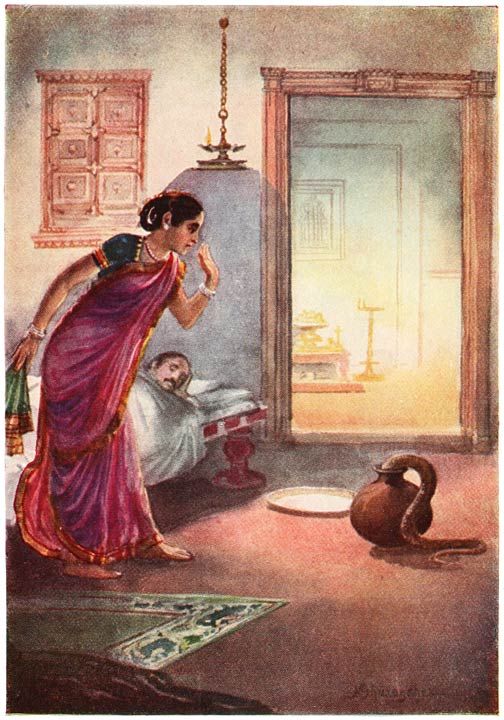
(Pramadavara and the snake)

The origins of Ruru and of Pramadvara

Now Vrigu's son Chyavana had a wife named Sukanya and Sukanya begat in turn Pramati, and Pramati had a son whom he called Ruru

Not many years after Ruru was born it happened that Menaka, one of the dancing girls [apsaras] in the Court of the god Indra, fell in love with Visvavasu the King of the Gandharvas. King Visvavasu returned her love and Menaka bore to him a baby daughter. To hide her marriage from the god Indra, she left the baby girl by the banks of a great river, which flowed past the hermitage of the mighty rishi Sthulokesha. Sthulokesha had a kind heart and he pitied the little baby girl, who lay helpless among the reeds of the river. He lifted her in his arms and took her to live with him in his hermitage. And because she was the daughter of an immortal mother she surpassed in beauty all the daughters of men. But she was not lovely in face alone. Her heart was full of goodness and she loved the rishi Sthulokesha as if he had been her father. And because of her many virtues and of her love for him Sthulokesha named her Pramadvara. 

Ruru falls in love

One day when Ruru was still a youth he wandered somewhat far into the forest. As he wandered, he suddenly saw in front of him the hermitage of the rishi Sthulokesha. And as he looked at it wondering what mighty sage lived there the beautiful Pramadvara came to the door. Instantly his heart was smitten with love for her. And going back to his father he said, "I have seen the loveliest girl in all the world and unless I wed her I shall die of love for her." 

Hearing Ruru's words and seeing his son's distress, Pramati went straight to the hermitage of Sthulokesha that stood in the heart of the forest. Bowing respectfully to the great rishi, Pramati addressed him saying, "Venerable Sir, my son Ruru has reached the age for marriage. Wandering through the woods he came to your hermitage and, seeing your daughter Pramadvara, was smitten with love for her. I have therefore come to beg you to give her in marriage to my son." 

Sthulokesha received Pramati with all honour and told him the story of Pramadvara's birth. Pramati heard the tale but still pressed for her marriage to his son. So Sthulokesha consented and he and Pramati betrothed Ruru to Pramadvara and appointed a day for their marriage, when the stars favourable to the youth and maiden were high in the heavens. 

The crisis

But a few weeks before the day appointed for the ceremony, the beautiful Pramadvara was playing with some fair maidens of her own age near Sthulokesha's hermitage. In a bush near by lay a poisonous snake asleep. As Pramadvara ran, her foot pressed one of the snake's coils. Instantly it awoke and raising its head struck at Pramadvara, fastening its fangs in her bare foot. The poison coursed through her veins, the colour left her cheeks and she sank dying to the ground like a lily struck by the sun. 

Sthulokesha was well-nigh mad with grief when he heard of the maiden's death. Pramati, too, sorrowed much. But Ruru grieved more even than Sthulokesha, because his love for Pramadvara was the greatest. Praying to the Immortals he recited his charities and his penances, his virtues and his austerities, that they might feel pity and restore to him the bride whom he so desired. 

As he prayed he saw a kingly figure come towards him from the forest. As the stranger drew near he said to Ruru, " O noble-minded youth, I am a messenger of the Immortals. They have noted your many good works and your pure life and they pity you deeply. But one whose span of life is ended cannot be saved from death. Pramadvara had lived the full number of her destined years. The gods, therefore, cannot bring her back to life. But if you, O Ruru, give up half your life to Pramadvara the gods will bring her back to you and you will live happily together." 

Ruru's heart leapt with joy when he heard the words of the messenger of the Immortals. "O herald of the gods,' he cried, "gladly will I give half my allotted span of life that Pramadvara may live again and be my bride." 

When the messenger of the Immortals heard Ruru's reply he vanished into the skies that he might tell it to the gods who had sent him. Ruru left the spot and hastened to where Pramadvara's body lay, to see if she lived or was dead. 

Pramadvara revived and Ruru's revenge

As he came close to her he saw that she still lay without motion. But a faint colour seemed to grow in her cheeks and on her pale lips. Her eyelashes began faintly to quiver. At last, waking up as if from a deep sleep, she opened her eyes and, seeing Ruru near her, smiled softly at him. 

Then Ruru told Sthulokesha and Pramati that Pramadvara had come back to life. And Sthulokesha and Pramati were overjoyed, and when the appointed day came, they joined the youth and maiden together in wedlock. 

But because a snake had bitten the lovely maiden whom Ruru loved better than life itself, he hated from that day the whole race of snakes. And whenever he saw a snake in the grass or the woods he either struck it with his staff or cut it in pieces with his sword. 

Ruru and the rock snake

One day, when Ruru was wandering through a dense part of the forest, he saw an old rock snake lying on the ground. Instantly he raised his staff to strike it. But the rock snake cried to him with a human voice, "Great sage, I have done you no hurt. Why are you angry with me and why do you seek my life?" 

"My beloved wife," answered Ruru, "was once killed by a snake. I vowed, therefore, in my anger that I would slay every snake I saw. Therefore, O snake, prepare yourself for death, for I shall surely kill you." 

"Venerable Sir," said the rock snake piteously, "I am not a poisonous snake. Rock snakes are but snakes in name for they cannot kill men even if they wish. Therefore we do not share the guilt of the snake people for the death of your wife. And it is your duty not to kill but to spare me." 

Ruru looked closely at the rock snake and seeing that it had no poison fangs felt pity for it. He dropped his staff to his side and said, "O snake, tell me, I pray you, who you are. For you speak as a human being and I think you were once a man." 

"Great sage, what you say is true. Once I was a youth of your own years and by caste a Brahman. My name was Shahasrapata. But an angry wizard cursed me and thus changed my shape." 

Then Ruru said, "Pray tell me, good snake, the tale of your ill fortune." 

The snake's story

"Venerable Sir," answered Shahasrapata, "I had a friend named Khagama. We played and grew up together. But whereas I took a joy in the pleasures of life, Khagama studied the works of the great rishis and by bitter penances attained their powers. One day when I returned home I saw Khagama plunged in meditation. Out of malice, I plaited together some strands of grass until they had the appearance of a snake. Going on tiptoe behind Khagama I placed the plaited grass upon his shoulder. Looking round with a start he saw, as he thought, a venomous snake upon his shoulder and he fainted with fear. Then I mocked him because he had feared a strand of plaited grass, until his fury was roused against me. 'Shahasrapata,' he said , 'you frightened me with a mock harmless serpent, so become now a mock harmless serpent yourself, to frighten others.' Then, great sage, I repented of what I had done and joining my hands I bowed low before Khagama. 'I am your friend,' I pleaded; 'I meant no harm. I only wished to make you laugh. Take back your curse from me.' Khagama saw that I truly repented. But he said, 'O Shahasrapata, what I have said must happen. And a rock snake you must become. But when Ruru the son of Pramati appears to you, you will once more assume human form.' Therefore, O sage, I became a rock snake. But as you, Ruru, the son of Pramati, have appeared to me I shall once more become human." 

And as Shahasrapata spoke, Ruru saw him change swiftly into human form. 

When he had once more become a man he said to Ruru, "The highest morality, O sage, is this: destroy no life. Therefore do not wage war any more on the snake people. But spend your days in peace, enjoying the beauty of Pramadvara." 

When Shahasrapata had spoken thus he left Ruru and went to his own home. Ruru retraced his steps to his hermitage. And giving up the slaughter of the snake people, he passed the remaining years of his life in great happiness with Pramadvara.


Sunday, July 9, 2017

0053. Parvati and the Bania's Son

From Deccan Nursery Tales, or Fairy Tales from the South by Charles Augustus Kincaid with illustrations by M. V. Dhurandhar, online at: Project Gutenberg.

Notes. The "Tuesday" in this title refers to "Mangalavar" is the day of Mangala (the planet Mars, as in the Roman tradition also), but this story associates the day not with Mars but with Mangal Gauri, another name for the goddess Parvati. You will also see Ganesha, the son of Parvati, playing a role in this story!

Summary: The goddess Parvati answers the prayers of the bania's wife so that she has a son, and then the goddess watches over the boy as he grows up.

Read the story below:


THE TUESDAY STORY: PARVATI AND THE BANIA'S SON


The Bania's Wife

Once upon a time there was a town called Atpat. In it there lived a bania who had no son. Every day a religious mendicant used to come to his house and call out, “Alms! Alms! In the name of God, give me alms.” But when the bania’s wife offered him alms he refused them, because she had no children.

She told her husband, who advised her to play a trick on the mendicant. She hid behind her door, and as he called out “Alms! alms!” she slipped a gold piece into his wallet. But the mendicant caught her and became very angry. He cursed her and told her that she would always remain without any children.

She was terrified and fell at his feet and begged for forgiveness. Then he pitied her and said, “Tell your husband to put on blue clothes, mount a blue horse, and ride into the jungle. He should ride on until he meets a horse. He should then dismount and dig in the ground. He will in the end come to a temple to Parvati. He must pray to her and she will bestow a child on him.”

The Bania and Parvati

When her husband came back, she told him what had happened. So he at once put on blue clothes, mounted a blue horse, and rode into the forest. He met the horse, dismounted, and began digging. At last he discovered a temple to Parvati, all of gold, with diamond pillars and a spire made of rubies. Inside was a statue of the goddess, and to it he prayed, saying, “I have houses and cottages, cattle and horses, money and goods of all kinds, but I am very sad because I have no son.”

The goddess pitied him and asked, “Which will you have, a son who will be good but will die young, or a son who will live long but will be born blind?”

The poor bania became greatly perplexed, but at last said, “I choose a son who will be good but will die young.”

The goddess said, “Very well. Step behind me. There you will find an image of Ganpati [Ganesha]. Behind it is a mango tree. Climb upon Ganpati’s stomach and pick one mango. Go home and give it to your wife to eat, and your wish will be gratified.” Parvati then disappeared.

Ganesha and the Mangoes

The bania climbed upon Ganpati’s stomach and ate as many mangoes as he could. He next filled a large bundle full of mangoes and stepped down. But when he reached the ground he found that there was only one mango in the bundle. He climbed up again and refilled his bundle, but when he stepped down he again found only one mango. This happened three or four times.

At last Ganpati got very sore and angry with having his stomach trampled on. So he shouted out, “One mango is all you’ll get. So be off home!”

The bania was frightened out of his wits and galloped home with his one mango. His wife ate it, and in nine months she presented her husband with a son.

When the little boy was eight years old his sacred thread was put on, and his mother said, “It is time to think of his marriage.”

But the bania said, “I dare not marry him unless he first makes a pilgrimage to Benares.” His maternal uncle agreed to take the little boy to Benares.

A Marriage

So off they started together, and some days later the uncle and nephew halted at a village where some little girls were playing.

One of the little girls said to the other, “You are nothing but a wretched little widow.”

But the other little girl said, “Oh no! there are never any widows in our family. Mother worships Parvati and so I can never be a widow.”

The uncle heard this, and thought that if his nephew could only marry a little girl who could not become a widow, he would not die young. So he began to think how he could bring about the marriage.

Now it so happened that the little girl was to be married that day. But in the morning the boy to whom she was betrothed fell ill. Her parents were in great trouble, but at last they thought that, rather than postpone the wedding and disappoint all the guests, it would be better to marry their little daughter to the first traveller who passed through the village.

So they went to the rest-house to inquire if anyone was there. There they found the uncle and nephew, and they married their little girl to the latter that very evening when the cows were homing.

A Vision of Parvati

They drew on the wall a picture of Shiva and Parvati, and they put the children to bed beneath it.

Parvati appeared to the little girl in her sleep. The goddess said, “My child, a snake will come to bite your husband; give it milk to drink. Then put near it a new earthen jar. When the snake has finished drinking, it will enter the earthen jar. Then at once pull off your bodice and stuff it into the jar’s mouth. Next morning give the jar to your mother.”

Next evening everything happened as Parvati had said. The snake came to bite her husband as he slept. But the little girl offered it milk, which it drank. After drinking, it curled itself up inside the earthen jar, and, the moment it did so, the little girl slipped off her bodice and stuffed it into the mouth of the jar.

The Separation

Next morning her husband gave her a ring, and she in exchange gave him a sweet-dish, and he and his uncle continued their journey to Benares.

When they had gone, the little girl gave the earthen jar with the snake inside it to her mother. The mother took out the bodice, but instead of a snake a garland lay inside, and the mother put it round her little daughter’s neck.

Some weeks passed, but neither uncle nor nephew returned. So the little girl’s parents grew anxious. The sick boy who was to have been her husband recovered, but she could no longer marry him, and the boy whom she had married had gone away and might never return.

In despair the parents built a house, in which they entertained every traveller who passed by, hoping that sooner or later one of the travellers would prove to be their daughter’s husband. To all of them the mother gave water; the daughter washed their feet; her brother gave them sandalwood paste; and her father gave them betel nut. But it was all in vain; none of the travellers’ fingers fitted the ring given to the little girl by her husband, nor could any of them produce the sweet-dish which she had given him in exchange.

Another Vision

In the meantime the uncle and nephew had reached Benares and had given large sums in charity, and had visited all the holy places and had received the blessings of all the Brahmans.

One day the little boy fainted. And in a dream he saw the messenger of Yama, the god of death, come close to him as if to carry him off. Next he saw the goddess Parvati come to his rescue and, after a struggle, drive away Yama’s messenger.

When the boy woke up he told the dream to his uncle. The latter was overjoyed because he felt certain that now the boy would no longer die young. He told his nephew to get ready, and next day they left Benares.

Reunion

On their way home they passed by the village where the nephew had been married. As they were having breakfast near the village [water] tank, a maid-servant invited them to come to the house which the girl’s parents had built for the reception of travellers. At first the uncle declined, but when a palki was sent for them, he and his nephew entered it.

When the little girl began to wash her husband’s feet, she recognised him. She tried on the ring, which fitted his finger, and he in turn showed her the sweet-dish which she had given him. The parents were as pleased as possible, and they sent a messenger to invite the boy’s parents. They came, and the boy’s mother threw herself at her daughter-in-law’s feet and thanked her for saving her son.

Then there was a great feast and everybody was very happy indeed, and at the end they all worshipped Parvati, so she became as pleased as everybody else.


Friday, June 30, 2017

0041. Princess Lavanyavati and the Gandharva

From Tales of King Vikrama translated by C. A. Kincaid with illustrations by M. V. Dhurandhar, online at: Internet Archive.

Notes. This is Kincaid's translation of the Marathi version of the classic Vetal Panchvishi, a collection of stories takes the form of riddles: a vetala (what you could call a ghost or vampire in English) asks the riddles, and the King Vikrama answers. You can read more about this masterpiece of Indian classical literature at Wikipedia.

Summary: This story tells what happen when the prince's beloved wife is kidnapped by a gandharva.

Read the story below:


PRINCESS LAVANYAVATI AND THE GANDHARVA


(M. V. Dhurandhar)


The ghost tells King Vikrama this story:

Once upon a time there was a town called Chudapur. In it there lived a king called Chudamani. He had a guru or spiritual teacher named Devaswami and a son called Hariswami. The latter was as beautiful as Kamdev the god of love; he was as learned in the sacred books as Brihaspati the teacher of the gods, and
he was as rich as Kuber the god of wealth.

The king married his son Hariswami to the daughter of a neighbouring king called Krishnaswami. Her name was Lavanyavati. She was a beautiful girl and both prince and princess loved each other and were as happy as possible.

Princess Lavanyavati and the Gandharva

One summer night the prince and princess went to sleep on the terrace of a house in the woods. As the princess slept her bedclothes slipped off to one side, exposing her beautiful face.

Now it so chanced that a Gandharva was just then riding through the sky in his air chariot. Looking down, his gaze fell on the lovely princess and instantly he fell in love with her. Silently he brought his chariot down until it rested close to where the princess slept. Then lifting her up so skilfully that she never woke, he placed her in his air chariot and soared into the heavens.

When prince Hariswami awoke, he noticed that his wife was no longer near him. Alarmed, he went downstairs and began to search the house, but it was of course hopeless to search for one whom a Gandharva had borne away. He returned to his father's city and searched in every lane and street. At last he began to despair.

"Someone," he said, "must have taken her away, but where he
took her I cannot guess." Going home he sat down and began to weep and lament. Then twice more he searched the whole town through, but all in vain.

When he again returned to his palace it seemed a desert without his beloved bride, so he sat down more despairing than ever. "My Beloved," he mourned, "you who were so good and sweet, I cannot live without you." So he wailed for days together.

The prince-beggar

At last his grief became more than he could bear. He rose and abandoning his house, rank and wealth, he became a wandering beggar. He flung aside his princely robes and put on nothing but a loin cloth. Then smearing his body with ashes he left the city and bareheaded and all but naked he roamed from shrine to shrine and from one town to another.

One day he went faint with hunger with a begging bowl in his hand to the house of a Brahman and asked for food. Now a beggar should go to a rich man's house, and not to that of a poor Brahman. But when a man is distracted with love, he can think neither of his caste nor his religion, nor does he care what or when or where he eats or drinks.

The Brahman bade his wife give the beggar some food. So she poured some milk into his begging bowl. With it Hariswami went to a banyan tree by the edge of a lake and putting his bowl on the ground went fast asleep.

It so chanced that a snake crept out and drank up part of the milk without Hariswami seeing it. When the prince woke up, he drank the poisoned milk and died very soon afterwards.

The ghost's riddle

At this point the ghost said, "King Vikrama, who was to blame for the prince's death? Was it the Brahman, the wife or the snake?"

"None of them," answered king Vikrama indignantly. "The Brahman did an act of charity. His wife obeyed her husband's order. The snake was a poisonous snake and could not help being so. For that was its nature. Nor was Hariswami guilty of suicide. For he did not know that the snake had touched the milk. Indeed," continued King Vikrama growing more and more heated, "if anyone were to fasten the guilt of the prince's death on any one of those four persons, he himself would be the guilty one."